 : 0
: 0  : airQuality0
Online Consultation

Official Media
 Online Complaint
 LONGHU MOUNTAIN
Attraction Introduction
General Pavilion
发布时间:2025-06-27 19:02:23
浏览量:688
智能播报
「
Longhu Mountain Scenic Area - General Pavilion 」
将军亭
将军亭&十位将军介绍
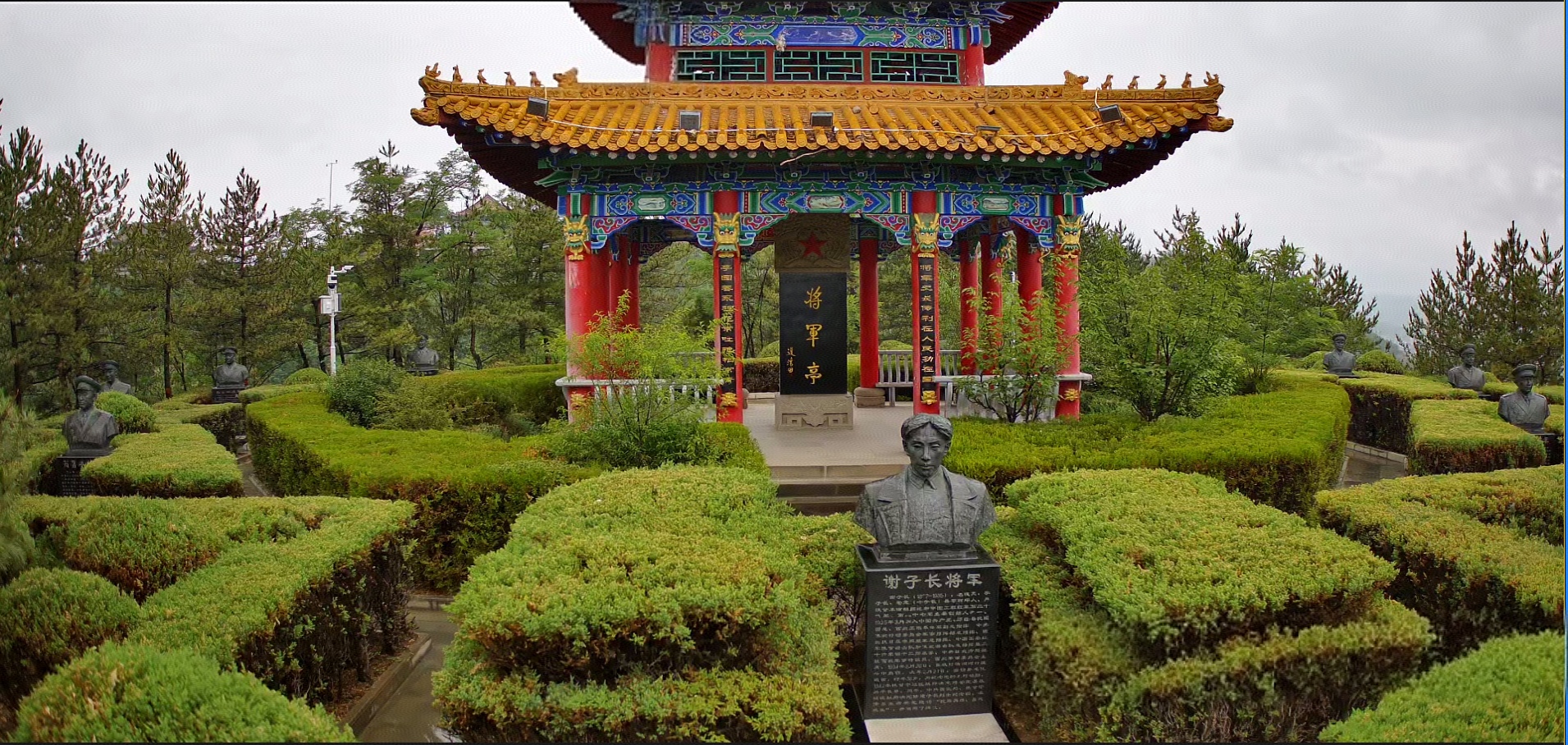
将军亭
The General Pavilion is the core building of the General Memorial Park. The stone tablet erected in the center of the pavilion is engraved with the three characters "General Pavilion", which was personally inscribed by Chi Haotian, former Vice Chairman of the Central Military Commission. The handwriting is strong and powerful, with profound meaning. The bronze figures surrounding the General Pavilion are the heroic figures of ten generals, including Xie Zichang and Yan Hongyan. As the main creators and leaders of the Northwest Red Army and the Northwest Revolutionary Base, they have made immortal contributions to China's revolutionary cause.
Xie Zichang, born on January 19, 1897, embarked on the revolutionary road in 1924 and joined the CPC in 1925. He led the people of the entire county to severely punish local tyrants and evil gentry, expel usurers, abolish excessive taxes and levies, carry out military campaigns, and crush the first "encirclement and suppression" of the revolutionary base in northern Shaanxi by the Kuomintang army. In 1934, General Xie Zichang unfortunately suffered serious injuries during the Battle of Hekou. Due to the worsening of his injuries, he passed away on February 21, 1935! Chairman Mao wrote inscriptions for two people throughout his life, one was his mother and the other was Xie Zichang. The guerrilla forces in northern Shaanxi, Ah, Commander Lao Xie. They opened up that stable city, Ah, the mountains and rivers are all red! "" National heroes, even though they die, they still live
Yan Hongyan, born on October 26, 1909, joined the army at the age of 15 and joined the "Xuebing Company" established by Li Xiangjiu. Despite his young age, he worked diligently and was guided by Li Xiangjiu. At the age of 16, he joined the party organization! During the War of Resistance Against Japan, Yan Hongyan's main job was to safeguard the security of Yan'an. During the Liberation War, he participated in the liberation wars in Hebei, Shandong, Henan and other places. After liberation, he stayed in Sichuan to work and served as the Vice Governor of Sichuan Province, overseeing the work in Chongqing. In 1959, Yan Hongyan was transferred to the position of Secretary of the Yunnan Provincial Party Committee.
Wu Xizhi, born in 1913, lived in Xiahe Beach, Wayaobao Town. He studied private school when he was young, and later became the second highest primary school in Wayaobao. He joined the CPC in 1930 and the Red Army in 1935. From March 1937 to the second half of 1939, worked at the Eighth Route Army's office in Shaanxi. After the establishment of the People's Republic of China, he served as the Deputy Commander of the Shenyang Military Region.
Li Churan, born in 1914, resided in Miliangshan, Wayaobao Town, Zichang City. His father is a well-known craftsman with a decent income. Li Churan did not disappoint his father's expectations and went to a normal university, becoming a cultured person. He actively studied the ideological theory of our party and completed many important tasks, but after a secret intelligence was sent out, he caught the attention of the enemy and was quickly arrested and imprisoned. He did not waver from various punishments imposed by the enemy, and our party rescued him in a timely manner. As his identity as a secret worker had been exposed, in order to protect Li Churan, our party transferred him to work in the Shaanxi Red Army!
Chen Kegong, born in Chenjiadonggou Village, Zichang Shijiapan Township in July 1910, joined the CPC in 1934 and joined the Chinese Workers' and Peasants' Red Army in 1935. He served successively as the military minister of the Soviet government of our county, the political commissar of the Shanxi Suiyuan Joint Defense Corps, and after the founding of the People's Republic of China, he served successively as the deputy minister and political commissar of the logistics department of the Lanzhou Military Region.
Jiang Juhua, born in 1933, graduated from the Fourth Military Medical University and began serving as the dean in 1964. After the Tangshan earthquake in 1976, the Third Army Hospital of the People's Liberation Army in Baoji received more than 300 seriously injured patients. He led the technical backbone to investigate the condition of the injured one by one, formulate treatment plans, and after careful treatment and nursing, all the injured were cured. Jiang Juhua has written over forty papers in more than thirty years of hospital management practice, of which more than ten were rated as excellent papers at national and military academic conferences.
He Yi, the son of the founding general He Jinnian, was born in 1929. We all know that the Sanmenxia Water Conservancy Hub Project was built with the help of Soviet experts. However, after three years of storage, the siltation exceeded 4.4 billion tons, and the Wei River was blocked and diverted, seriously threatening the safety of the 800 mile Qin River and the ancient city of Xi'an. After repeated research and reconstruction, He Yi and others have significantly improved the flood discharge and sediment discharge capacity of the dam.
He Jixiang, who joined the revolution at the age of 17, was appointed as the captain of the assault team during the Red Army's Eastern Expedition in 1936. He led the assault team to launch a fierce attack on the enemy, and the troops were able to successfully break through. He Jixiang, who had made great contributions, could have been appointed as the team leader. However, his brother succeeded in selecting talents and avoiding relatives, and promoted him to deputy team leader. After the establishment of the People's Republic of China, He Jixiang successively held positions such as Deputy Commander of the 38th Army and Deputy Commander of the Jilin Army
Gao Weisong, born in 1916, was gifted and diligent in his studies from a young age. He worked as a tutor for the son of a landlord and also worked as a shepherd in his youth. In 1931, he was admitted to the First High School in Anding County. Influenced by underground party member and principal Guo Langting, he became a secret liaison officer and traffic officer for the Communist Party organization after graduation. He went to the city multiple times to purchase firearms and ammunition for the guerrillas!
He Jinnian, born in 1910 in Hejiawan Village, Yujiawan Town, Zichang City, had a pair of brothers who became founding generals at the same time. They were He Jinnian and He Jixiang. He Jinnian participated in the revolution under the influence of Xie Zichang, so he followed Xie Zichang in the revolution after reaching adulthood. After the outbreak of the War of Resistance Against Japan, He Jinnian successively served as the commander and brigade commander of the Left behind Army Corps. During the Liberation War, He Jinnian fought in the Northeast region and successively served as the commander of the 11th Dongye Column and the deputy commander of the 15th Army Corps
- END -
